
French Southern and Antarctic Lands
The French Southern and Antarctic Lands is an overseas territory of France, at the bottom of the world. UN Tourism publishes no arrivals figure for it, so Globestamp places its stamp by estimate: Mythic, for fewer than 50,000 visitors a year.
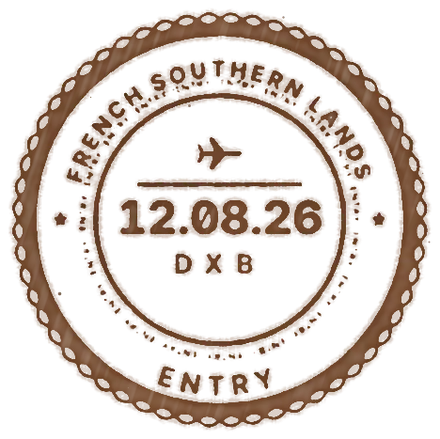
- Stamp finish
- Mythicplaced by estimate
- Area
- 7,257 km² (2,802 sq mi)
- Population
- 140Natural Earth estimate
- Regions
- 4in Globestamp’s regions layer
Does the French Southern and Antarctic Lands count as a country?
It depends on the list. The French Southern and Antarctic Lands is an overseas territory of France, so it is not one of the UN’s 193 members, but Globestamp’s list of 250 countries and territories counts it on its own. The Travelers’ Century Club counts it as “French Antarctica (Adélie, Kerguelen)”.
| List | Counts the French Southern and Antarctic Lands? |
|---|---|
| UN member states (193) | No |
| Globestamp’s countries and territories (250) | Yes |
| Travelers’ Century Club (330) | Yes, as French Antarctica (Adélie, Kerguelen) |
| European Union | No |
| Schengen area | No |
The French Southern and Antarctic Lands belongs to France, but travelers usually count it on its own, because it has its own entry rules, its own flag or its own place on the map. Other places in the same family: French Guiana, French Polynesia, Guadeloupe, Martinique, Mayotte, New Caledonia, Réunion and Saint Barthélemy.
The French Southern and Antarctic Lands stamp
Every country in Globestamp has its own stamp, drawn after a real entry stamp. Its finish shows how few travelers get there. The French Southern and Antarctic Lands’s is Mythic: a living finish taken from the place itself, the finish for places with fewer than 50,000 visitors a year. UN Tourism has no figure for the French Southern and Antarctic Lands, so its finish is placed by hand from what is known of its visitors. See every stamp on the stamp wall, or the rarest on the least-visited countries.
What counts as a visit to the French Southern and Antarctic Lands
The common rule among travelers is that you set foot there: an airport layover usually doesn’t count, and a port where you went ashore does. Globestamp counts the French Southern and Antarctic Lands when one of your photos was taken on its ground, or just off its coast; a photo taken from a plane never counts. The French Southern and Antarctic Lands has no airport with scheduled flights, so most visitors arrive by road, rail or sea. Read more in how to count the countries you’ve visited.
4 regions to fill in
Globestamp goes deeper than countries: its regions layer splits the French Southern and Antarctic Lands into 4 regions (Natural Earth’s first-level divisions), and each one fills in when a photo was taken there.
All 4
Amsterdam and Saint-Paul Islands · Crozet Islands · Kerguelen Islands · Scattered Islands in the Indian Ocean
Questions people ask
Is the French Southern and Antarctic Lands a country?
It depends on the list. The French Southern and Antarctic Lands is an overseas territory of France, so it is not one of the UN’s 193 members, but Globestamp’s list of 250 countries and territories counts it on its own. The Travelers’ Century Club counts it as “French Antarctica (Adélie, Kerguelen)”.
How many tourists visit the French Southern and Antarctic Lands?
UN Tourism, the usual source, publishes no arrivals figure for the French Southern and Antarctic Lands. Globestamp places its stamp by estimate, as Mythic: fewer than 50,000 visitors a year.
How rare is a French Southern and Antarctic Lands stamp in Globestamp?
It is printed in Mythic, the finish for places with fewer than 50,000 visitors a year. The fewer travelers a place receives, the rarer its finish, from plain Ink to Mythic.
Does the French Southern and Antarctic Lands count for the Travelers’ Century Club?
Yes. The Travelers’ Century Club counts it as “French Antarctica (Adélie, Kerguelen)”, one of its 330 destinations.
Places as rare as the French Southern and Antarctic Lands
Near the French Southern and Antarctic Lands
Sources
- Countries, cities and regions: Natural Earth 10m admin-0 (public domain); lists as of October 2026.
- Visitors: UN Tourism via the World Bank, ST.INT.ARVL (International tourism, number of arrivals), CC BY 4.0, data updated 2026-10-08. Each country's latest year before 2020. Countries count visitors differently; use as a rough rank.
- World Heritage Sites, parks, landmarks and the bucket-list places: Wikidata (CC0), as compiled in the app, October 2026.
- Airports: OurAirports (public domain), airports with scheduled service.
- Travelers’ Century Club: the club’s list of 330 destinations, as of January 2022.